In a recent study, researchers at Queen’s University Belfast—Connar McCluskey, Jams Dalzell, Amit Kumar, and led by Professor J. Marty Gregg—have provided new insights into how current flows through conducting domain walls in ferroelectric lithium niobate capacitors. These domain walls are of great interest for use in memristive devices, which can store and process information by switching and maintaining resistance states. Such devices are key candidates for future neuromorphic computing and low-power memory applications.
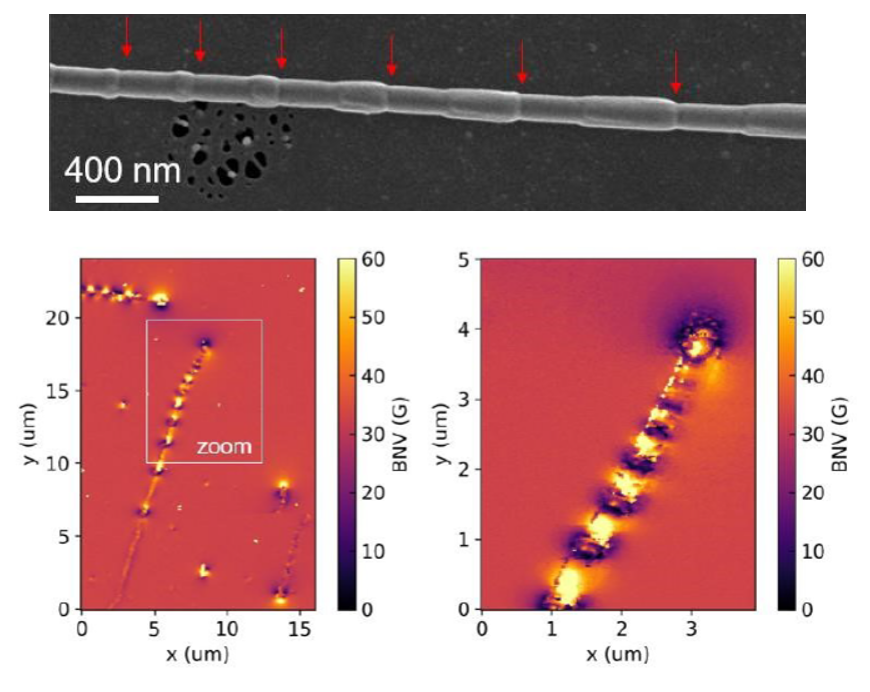
To probe the behavior of these walls, the team used a combination of scanning NV-center magnetometry, piezoresponse force microscopy (PFM), and conductive atomic force microscopy (c-AFM). While PFM was used to visualize the ferroelectric domain structure, and c-AFM to detect localized conductivity along domain walls, NV magnetometry allowed the team to directly image the distribution of current flow by measuring the nanoscale magnetic fields generated by electrical currents in the device.
The NV magnetometry measurements—performed using the Qnami ProteusQ quantum microscope—revealed that, contrary to common assumptions, only a limited number of domain walls actually carry significant current. The current pathways are sparse and spatially localized, leading to a major reassessment of charge carrier density estimates in these systems—by as much as two orders of magnitude in some cases.
This multimodal characterization approach provides a more accurate understanding of domain-wall-based conduction and highlights the importance of correlating structural, electrical, and magnetic measurements in complex nanoscale systems. The findings have direct implications for the design and modeling of future ferroelectric memristive devices.
Read more: McCluskey, C., Dalzell, J., Kumar, A., & Gregg, J. M. (2025). Current Flow Mapping in Conducting Ferroelectric Domain Walls using Scanning NV‑Magnetometry. Advanced Electronic Materials, 2200142.