Manipulating chiral spin transport with ferroelectric polarization

Image credit: https://www.nature.com/articles/s41563-024-01854-8

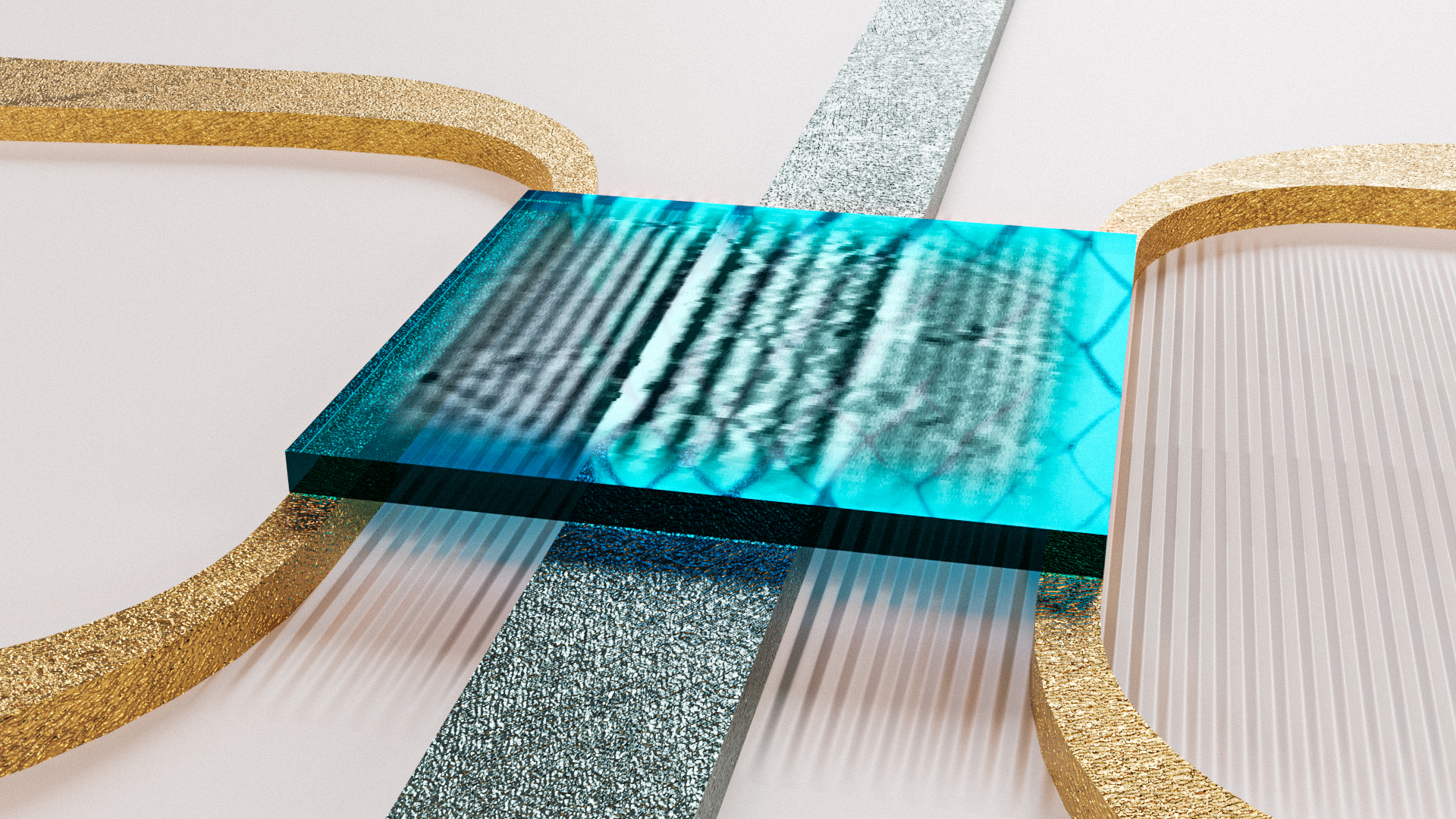
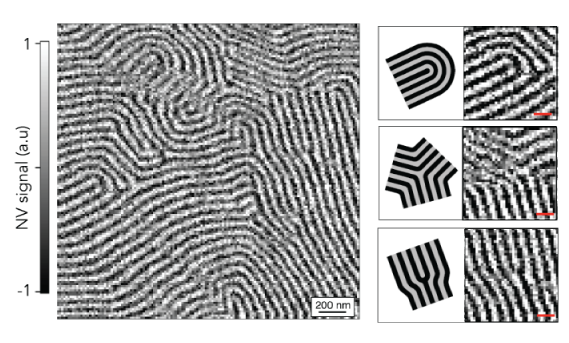
Magnons, a collective excitation of spins, enable low-dissipation information transport in magnetic insulators. Ramamoorthy Ramesh’s group has achieved a major breakthrough by demonstrating chiral spin transport in multiferroic BiFeO₃, controlled via ferroelectric polarization reversal, rather than traditional magnetic dipoles.

Their results show up to 18% modulation at room temperature, with spin torques capable of efficiently switching adjacent magnets—offering spin–torque efficiencies comparable to the spin Hall effect. By integrating spin–orbit injection, detection, and magnetoelectric control, the team demonstrated a fully functional, all-oxide, energy-scalable logic device.

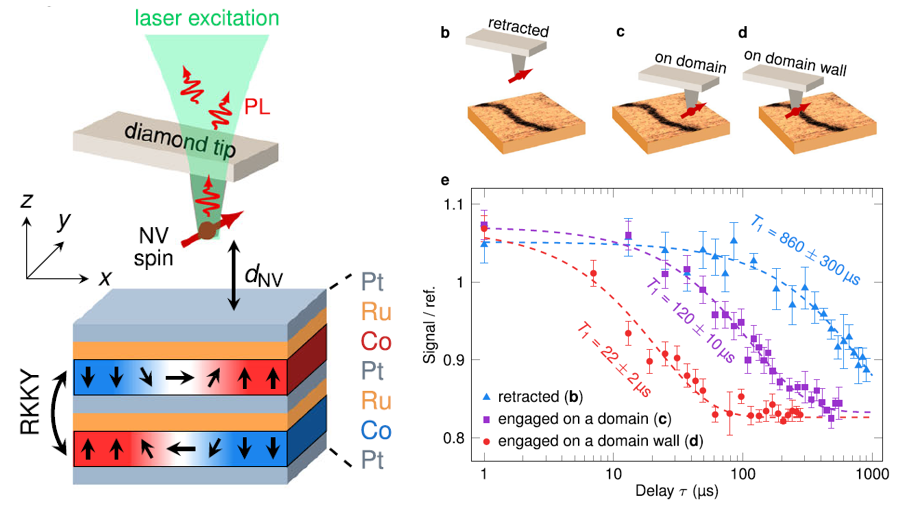
This pioneering work, supported by Scanning NV data from Proteus Q, opens new possibilities for low-dissipation nanoelectronics and the future of multiferroic magnonics.

 

See more applications

Nanoconfined Microwaves imaged by Rabi Oscillation Mapping

Swastik Kar’s group at Northeastern University used AC magnetometry on the Qnami ProteusQ to show that a permalloy nanowire can be used to concentrate RF fields into sub 300nm regions.

Spatial Resolution in Scanning NV Magnetometry – Technical Note

This technical note explains how spatial resolution is defined in Scanning NV Magnetometry. For a given distance d between the NV center and the scanned surface, the best achievable lateral spatial resolution is 0.86 d.

Want to know more?

Talk to us - our Application Scientist is happy to talk with you about what you can do with our Scanning NV Magnetometer ProteusQ.
We are using cookies and analytics tools to give you the best digital experience.
AcceptPrivacy Settings

GDPR

  • Cookie Consent

Cookie Consent

We are using cookies and analytics tools to give you the best digital experience.  Find more information and details about how to switch them off in our Terms of Website Use and Privacy Policy.