Atomically thin van der Walls magnets have been found to be not only an optimal platform for fundamental studies of magnetism in two-dimensional systems, but also promising candidates for next-generation spintronic devices. Bidimensional van der Waals magnets have been extensively investigated at micrometer scales. However, many of the relevant magnetic properties would be measurable only by probing materials at nanoscale resolutions.
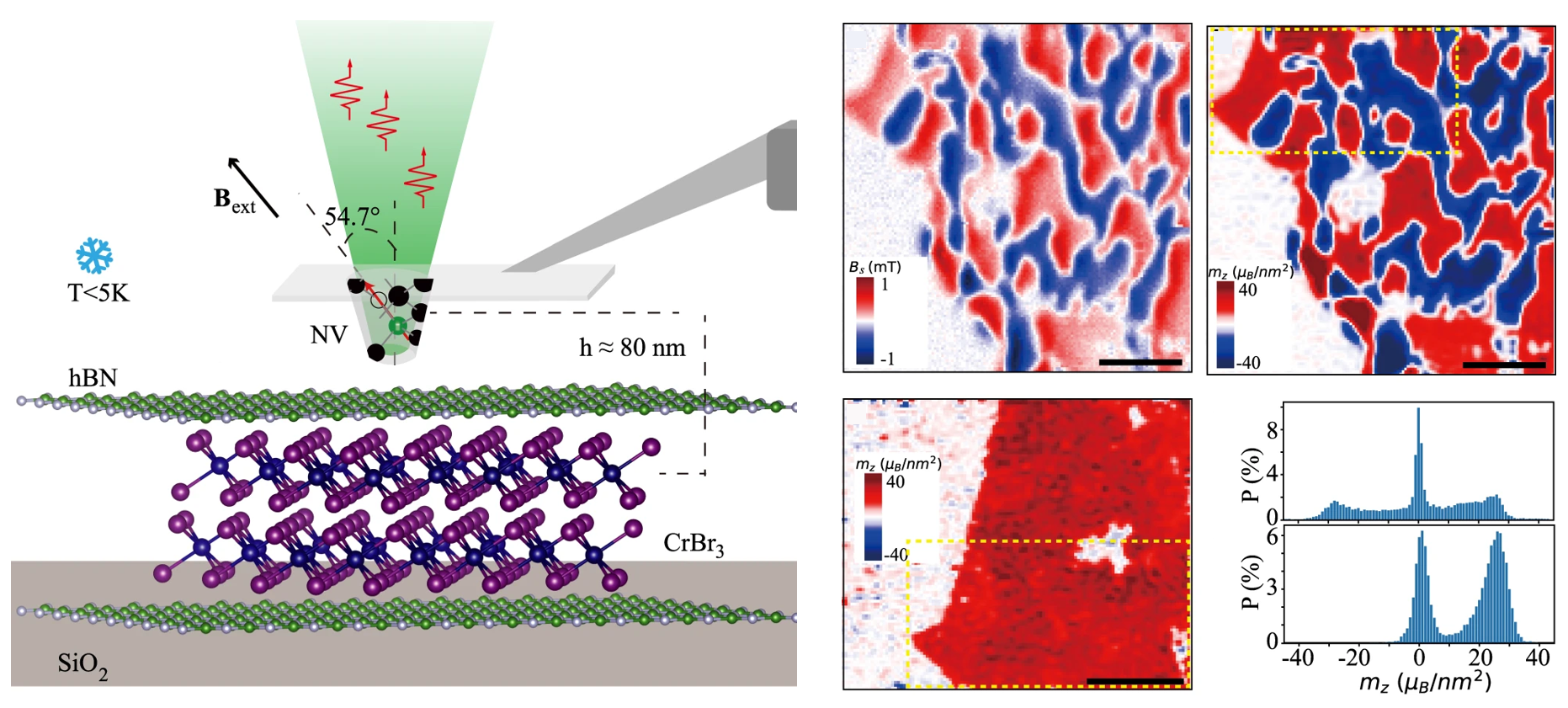
Professor Wrachtrup’s group and collaborators used Qnami Quantilever MX probes to assess nanoscale magnetic features of atomically thin bilayers of the ferromagnetic insulator CrBr3. The magnetic domains and their dynamics in CrBr3 have been predicted but never experimentally observed before.
The team proved the possibility of identifying magnetic domains and study their dynamics in bidimensional van der Waals magnets using scanning NV magnetometry in cryogenic (4K) environment. By using a pulsed measurement scheme, they achieved optimal magnetic field sensitivity and minimize sample heating due to continuous microwave.
The team was able to measure the stray magnetic field, determine the magnetization and identify the magnetic domains on the CrBr3 bilayer.
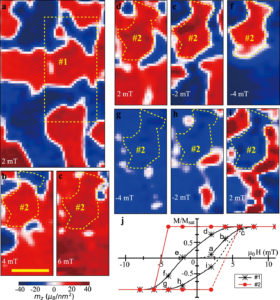
Image source: Nature Communications volume 12, Article number: 1989 (2021) – Published on March 31, 2021
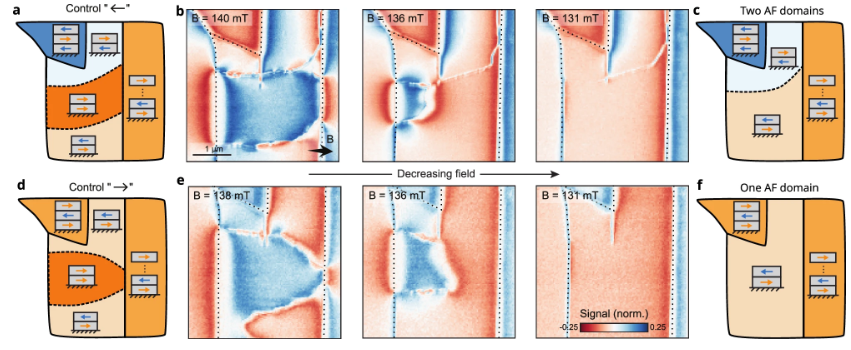
Researchers studied the evolution of magnetic domains as a function of changing external magnetic field. Domain wall pinning effects were observed and material defect sites identified.
This work opens the road to nanoscale magnetic characterization of bidimensional van der Waals ferromagnets using cryogenic NV scanning magnetometry with Qnami Quantilever MX probes, allowing a deeper understanding of such intriguing materials.
Read the full article in Nature Communications.