Nanoscale imaging of antiferromagnetic domains in epitaxial films of Cr2O3

Image credit: https://pubs.rsc.org/en/content/articlelanding/2023/ra/d2ra06440e

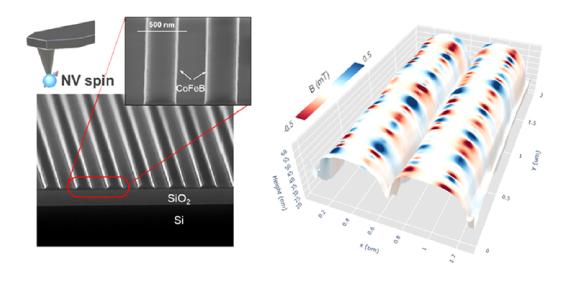
Researcher Abdelghani Laraoui and his team have used diamond nitrogen-vacancy (NV) microscopy to directly image boundary magnetization in antiferromagnetic Cr₂O₃ thin films, revealing a correlation between magnetic domain size and structural grain size.

Through field cooling, they demonstrated how an external magnetic field can influence the selection of 180° antiferromagnetic domains, a process linked to weak parasitic magnetization from defects. Additionally, by nanostructuring the films into mesa structures, they observed reversible edge magnetic states, which change direction based on the applied field during cooling.

This work provides valuable insights into antiferromagnetic domain formation and control, highlighting NV microscopy as an effective tool for studying nanoscale magnetism in spintronic materials.

 
Read the full article: RSC Adv., 13, 178-185 (2023)

See more applications

Morphogenesis of spin cycloids

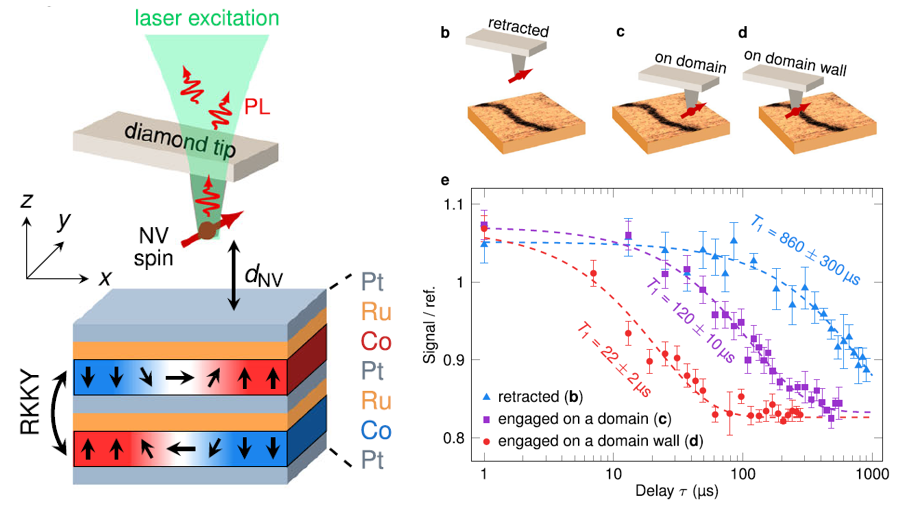
Researchers led by Ramamoorthy Ramesh used the Qnami ProteusQ™ quantum microscope to uncover how complex labyrinthine spin cycloids and their topological defects emerge in noncollinear antiferromagnets.

Probing Weak Magnetic Defects in Nanowires with Scanning NV Magnetometry

Scanning NV Magnetometry reveals nanoscopic weak magnetic inhomogeneities in nanowires never observed before by standard characterization tools.

Want to know more?

Talk to us - our Application Scientist is happy to talk with you about what you can do with our Scanning NV Magnetometer ProteusQ.
We are using cookies and analytics tools to give you the best digital experience.
AcceptPrivacy Settings

GDPR

  • Cookie Consent

Cookie Consent

We are using cookies and analytics tools to give you the best digital experience.  Find more information and details about how to switch them off in our Terms of Website Use and Privacy Policy.