Imaging antiferromagnetic spin cycloids in bismuth ferrite (BiFeO3)

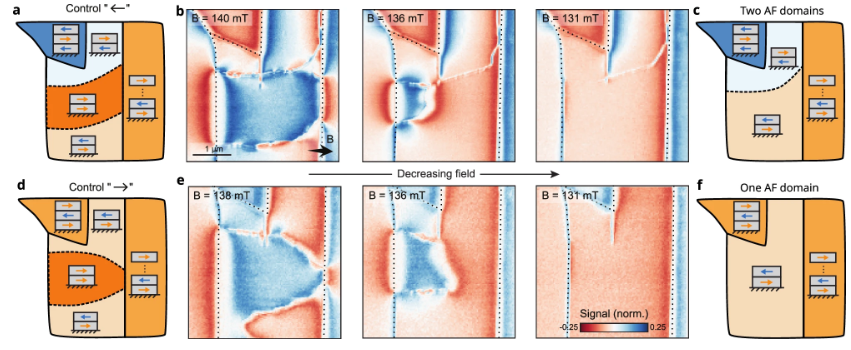
Antiferromagnets are magnetically ordered materials, where the directions of the atomic magnetic moments alternate, resulting in net macroscopic magnetization which is nominally zero. Beyond their fundamental interest, antiferromagnets present attractive features for future spintronic applications.

It is largely overlooked that these seemingly exotic materials are in fact widespread – a 90% majority of known magnets present such antiferromagnetic order. Well-studied examples include many metal-oxides, manganese-based alloys and rock salts as well as halides. Yet, the real-space observation of antiferromagnetic order remains a challenging task, in particular at the nanoscale.

It was recently realized that highsensitivity magnetic imaging of the stray fields (also known as demagnetizing fields) outside the material offers a powerful avenue to address nanoscale spin textures in antiferromagnets.

In this Application Note, we show how Qnami ProteusQ™ can be used to image antiferromagnetic spin textures with state-of-the-art accuracy. We present two modes of operation allowing to rapidly converge towards quantitative understanding of the magnetic textures at the surface of an antiferromagnet. We use BiFeO3 as a prototype example, where we reveal spin cycloidal antiferromagnetic order with a performance that compares favorably with the recent literature.
See more applications

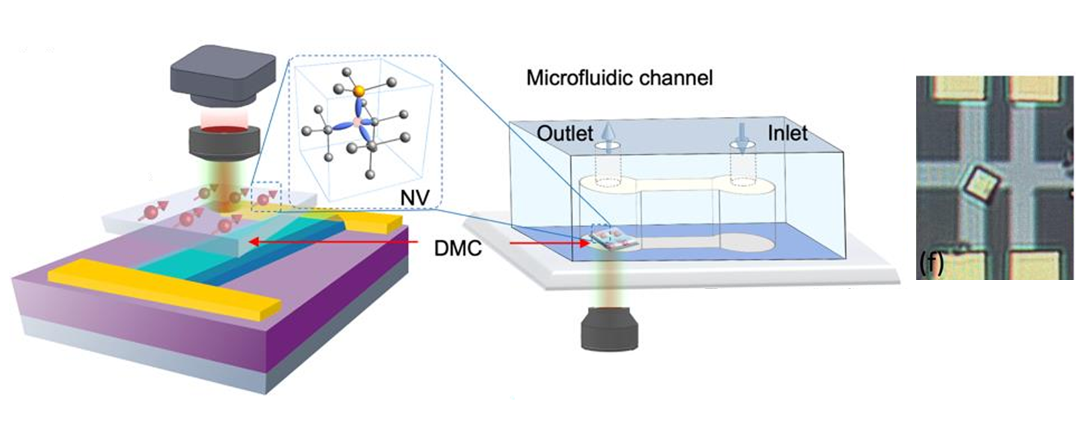
Qnami Foundry supports design of a Diamond micro-chip for quantum microscopy

Led by Mark Ku at the University of Delaware, this work characterizes a high-quality diamond micro-chip from the Qnami Quantum Foundry for advanced, high-resolution NV-based quantum microscopy.

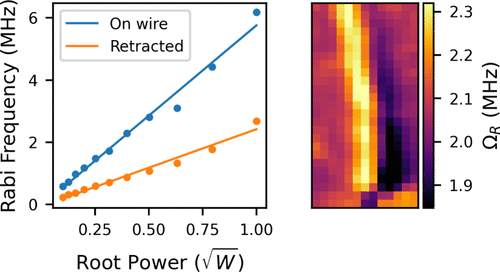
Nanoconfined Microwaves imaged by Rabi Oscillation Mapping

Swastik Kar’s group at Northeastern University used AC magnetometry on the Qnami ProteusQ to show that a permalloy nanowire can be used to concentrate RF fields into sub 300nm regions.

Current Flow Mapping in Ferroelectric Domain Walls

In a recent study on conducting ferroelectric domain walls, researchers used scanning NV magnetometry to directly visualize current flow at the nanoscale. These measurements were performed using the Qnami ProteusQ. The results challenge previous assumptions about current distribution and pave the way for more accurate modeling of next-generation memristive devices.

Do you want to know more?

Get in touch with us. We're happy to answer your questions.
We are using cookies and analytics tools to give you the best digital experience.
AcceptPrivacy Settings

GDPR

  • Cookie Consent

Cookie Consent

We are using cookies and analytics tools to give you the best digital experience.  Find more information and details about how to switch them off in our Terms of Website Use and Privacy Policy.